The persistent fragmentation in your UK customer experience is not a technology problem; it’s an organisational design flaw.
- Disconnected customer journeys stem from internal department silos, each with competing KPIs and inconsistent messaging.
- True omnichannel success requires dismantling these silos with cross-functional teams and shared goals *before* investing in expensive platforms.
Recommendation: Shift focus from buying a new Customer Data Platform (CDP) to piloting a small, cross-departmental ‘omnichannel squad’ to prove ROI with your existing tech stack first.
As a communications director in the UK, you witness the daily battle. The social media team launches a witty, meme-heavy campaign. The email marketing team sends a formal, product-focused newsletter. In-store staff are unaware of either promotion. The result? A disjointed, confusing, and ultimately frustrating experience for the very customer you’re trying to win. This isn’t just a minor inconvenience; it’s a direct erosion of brand trust and conversion rates. Your customers don’t see departments; they see one brand, and right now, that brand is speaking with a dozen conflicting voices.
Many leaders believe the solution lies in a better Customer Data Platform (CDP) or more sophisticated marketing automation. While technology is a powerful enabler, it is not the cure. Throwing a new platform at an organisationally fragmented company is like installing a state-of-the-art kitchen in a house with faulty wiring. The real issue, the one that most consultancies shy away from, is the structural debt within your teams. The departmental silos, the misaligned KPIs, and the lack of a shared messaging DNA are the true barriers to a unified customer experience.
But what if the key wasn’t a multi-million-pound tech investment, but a strategic shift in your organisational architecture? This guide moves beyond the platitudes of « being consistent » and provides a blueprint for breaking down those internal walls. We will dissect the financial imperative, provide a framework for coherent messaging, tackle the tech vs. structure debate, highlight a critical GDPR pitfall, and define how to measure what truly matters. It’s time to stop managing channels and start orchestrating experiences.
This article provides a detailed roadmap for UK communications leaders to diagnose and resolve the core issues preventing a seamless omnichannel experience. Explore the sections below to build a strategy that delivers true coherence and measurable results.
Contents: A Blueprint for a Unified UK Omnichannel Strategy
- Why Do Omnichannel UK Customers Spend 35% More Than Single-Channel Buyers?
- How to Build Message Frameworks That Work Across UK Email, Social, Web, and Retail?
- Technology vs Organizational Structure: Which Omnichannel Barrier to Fix First for UK Firms?
- The Omnichannel Integration Error That Violates UK GDPR Customer Data Rules
- How to Measure Omnichannel Strategy Success Using UK Cross-Channel Attribution Models?
- How to Enforce Brand Personality Across 50+ Touchpoints Without Becoming Robotic?
- How to Map UK Customer Journeys Across Digital Touchpoints in 4 Hours?
- Orchestrating Digital Touchpoints to Prevent UK Customer Journey Fragmentation
Why Do Omnichannel UK Customers Spend 35% More Than Single-Channel Buyers?
The mandate to unify customer experience isn’t driven by aesthetic preference; it’s a direct path to significant commercial uplift. The data is unequivocal: customers who engage with a brand across multiple, integrated channels are fundamentally more valuable. They don’t just buy more frequently; they spend more per transaction and exhibit far greater loyalty. This isn’t a global abstraction; it’s a proven reality in the highly competitive UK market.
Consider the powerful role of Click & Collect, a cornerstone of British retail. Research has revealed that a staggering 69% of UK shoppers now embed Click & Collect into their regular shopping journeys. Their motivations are clear: 28.9% use it to save on delivery fees, and 24.9% value the speed. But the real insight for strategists is that shoppers spend an average of 14% more when they opt for Click & Collect compared to home delivery. This isn’t accidental. The journey from an online browse to an in-store pickup creates a new touchpoint, an opportunity for further engagement, and a moment where a well-trained associate can add value.
This spending uplift is a direct result of a coherent experience. When an online journey flows seamlessly into a physical one, the customer feels understood and valued. The convenience of the service reduces purchase friction, and the physical store visit provides an opportunity for impulse buys or discovering complementary products. An omnichannel customer is not just a consumer; they are an active participant in an ecosystem you’ve built. The 35% figure isn’t a target; it’s the financial consequence of getting the experience right.
How to Build Message Frameworks That Work Across UK Email, Social, Web, and Retail?
A unified customer experience is built on a foundation of message coherence. Without a shared framework, your channels will inevitably descend into a cacophony of conflicting tones, offers, and objectives. The goal is not to make every channel sound identical—a tweet is not a B2B email—but to ensure they all sing from the same hymn sheet, reinforcing the same core brand promise. This requires a robust, yet flexible, messaging architecture.
A powerful approach is the CORE framework, which forces teams to consider four critical elements for every communication:
- Context: Adapting the message to the norms of the channel (e.g., professional on LinkedIn, conversational on WhatsApp) while retaining the core brand voice.
- Objective: Defining a single, clear goal for each message to avoid confusing the customer.
- Resonance: Using UK-specific cultural touchstones, humour, and references to create a genuine, local connection.
- Echo: Ensuring each message connects to the previous and next touchpoints, maintaining a continuous conversation across channels.
This framework moves teams from simply pushing out content to strategically orchestrating a conversation. It builds consistency without sacrificing creativity or channel-specific effectiveness. The physical retail environment is a critical part of this echo chamber, where technology can bridge the digital-physical divide.
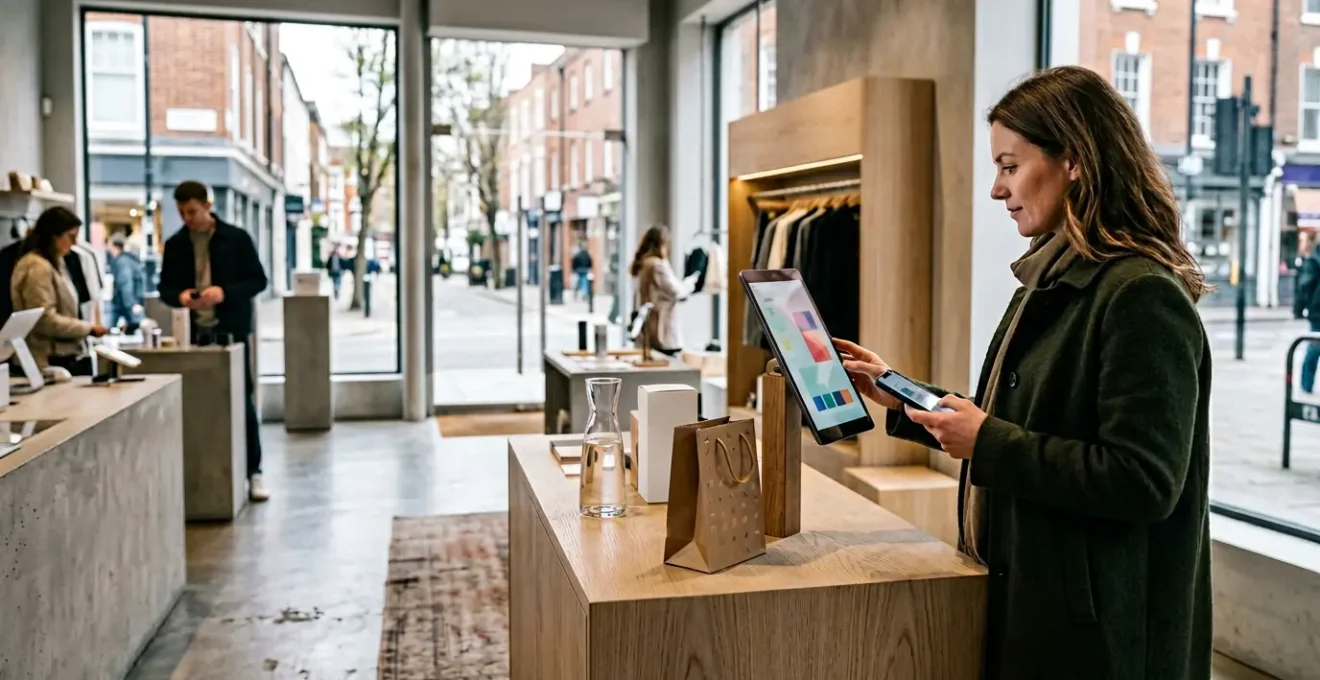
By equipping in-store associates with tools to see a customer’s online journey, as shown above, they can transform a simple transaction into a personalised consultation. This is the CORE framework in action: the context is face-to-face, the objective is to assist, the resonance comes from personal interaction, and it echoes the customer’s prior digital behaviour.
UK Case Study: John Lewis’s Pioneering Omnichannel Structure
Long before ‘omnichannel’ became a buzzword, John Lewis was laying the groundwork. After pioneering Click & Collect in 2009, the company underwent a radical restructuring in 2011. They hired a new CIO who redesigned the entire model to ensure all channels—online, mobile, in-store, and call centres—worked as one. This involved overhauling their EPoS systems and supply chain to track every item across every channel. The result? By 2024, over 50% of their online orders are collected in-store, a testament to a strategy that put organisational integration first. Their efforts were recognised when they won ‘Omnichannel Retailer of the Year’ at the 2014 World Retail Awards.
Technology vs Organizational Structure: Which Omnichannel Barrier to Fix First for UK Firms?
There is a dangerous and expensive myth pervading UK boardrooms: that a sophisticated Customer Data Platform (CDP) is the silver bullet for omnichannel woes. The reality is that technology can only amplify the system it’s plugged into. If your system is one of departmental silos, misaligned goals, and internal friction, a new CDP will only amplify that chaos. The most significant barrier to omnichannel success is not technological; it is organizational.
Your marketing, sales, and service teams operate in fiefdoms. Marketing is judged on lead generation, sales on closed deals, and service on call resolution times. Without shared KPIs centred on the overall customer experience, these departments will inadvertently sabotage each other. The marketing team’s aggressive promotion creates a service backlog. The sales team’s promises aren’t supported by the delivery team. This is the structural debt that must be addressed first.
The solution is to prove the value of integration on a small scale before demanding a large-scale tech investment. A ‘structure-first’ pilot program allows you to demonstrate ROI using your existing tech stack, making the business case for further investment undeniable. The focus shifts from buying a solution to building a collaborative culture. This approach de-risks the transformation and builds momentum from the ground up.
Your Action Plan: The Structure-First Pilot Model
- Assemble the Squad: Create a small, agile ‘omnichannel squad’ with empowered members from marketing, sales, IT, and customer service who are given shared KPIs based on a unified customer outcome.
- Select the Journey: Choose one single, high-impact customer journey to pilot. Focus on a common pain point, such as cart abandonment recovery or the Click & Collect experience.
- Prove the Concept: Use your existing technology stack to integrate the process for this single journey. The goal is to prove the ROI of collaboration, not the power of a new platform.
- Break the Silos: Implement mandatory weekly cross-departmental stand-ups for the squad. This forces communication, breaks down « us vs. them » thinking, and maintains momentum.
- Build the Case: Meticulously document the success metrics (e.g., improved conversion, reduced service calls). Use these proven results to build an internal business case for a larger technology investment.
By fixing the organisational architecture first, you ensure that any future technology investment will accelerate success rather than automate dysfunction. It is a more patient but infinitely more effective path to true omnichannel maturity.
The Omnichannel Integration Error That Violates UK GDPR Customer Data Rules
In the quest to create a seamless 360-degree customer view, it’s dangerously easy to make a critical compliance error that puts your organisation on the wrong side of the Information Commissioner’s Office (ICO). The very act of integrating data from different touchpoints to ‘better understand the customer’ can lead to a direct violation of UK GDPR’s core principles if not handled with extreme care. The risk is not theoretical; an analysis of ICO actions reveals 32 UK GDPR enforcement actions in the first half of 2024 alone, showing that the regulator is actively pursuing non-compliance.
The most common and dangerous omnichannel integration error relates to the ‘purpose limitation’ principle. This principle states that data collected for one specific, explicit, and legitimate purpose cannot be used for another, incompatible purpose without fresh consent. This is where well-intentioned omnichannel strategies often fail.
For example, a customer provides their mobile number to receive an SMS delivery update for their online order. That is the specific purpose for which they gave consent. Later, the marketing team, having access to this integrated data, adds that mobile number to a WhatsApp marketing campaign list. This is a new purpose. Without separate, explicit consent from the customer to receive marketing messages via that number, your company has broken the law. The ICO is unequivocal on this point, as their guidance highlights.
The critical error is using data collected for one legitimate purpose (e.g., an SMS delivery update) for another purpose (marketing) without separate, explicit consent.
– Information Commissioner’s Office (ICO), UK GDPR Purpose Limitation Principle
A truly compliant omnichannel strategy requires meticulous data governance. It demands that your consent management platform is as integrated as your customer data. Every touchpoint must not only collect data but also capture the specific context and purpose of consent, making it visible and actionable across the entire organisation to prevent unlawful cross-use.
How to Measure Omnichannel Strategy Success Using UK Cross-Channel Attribution Models?
If you can’t measure it, you can’t manage it. A core challenge in any omnichannel strategy is proving its ROI, which is impossible when you rely on outdated, single-channel measurement models. With data showing that 73% of UK customers use multiple channels during their buying journey, attributing a conversion to the single ‘last click’ is not just inaccurate; it’s strategically blind. It systematically undervalues the crucial awareness and consideration touchpoints that initiated and nurtured the customer relationship.
To gain a true picture of performance, you must move to a multi-touch attribution model that distributes credit more intelligently across the entire journey. This isn’t about finding a perfect model—none exists—but about choosing the model that best aligns with your strategic goals. Last-click is simple but flawed. More sophisticated models like U-Shaped or Time-Decay provide a more nuanced view, helping you understand which channels are effective at starting conversations versus closing them.
The table below breaks down three common models and their application in a typical UK customer journey, helping you decide which is most appropriate for your business objectives. This analysis is the foundation of optimising your marketing spend and proving the value of every touchpoint, not just the final one.
Choosing the right attribution model transforms your analytics from a simple report card into a strategic decision-making engine. It allows you to invest confidently in top-of-funnel activities, knowing their value will be recognised, and to optimise the entire customer journey, not just the final step.
| Attribution Model | How Credit is Distributed | Best For | UK Example Scenario | Risk/Limitation |
|---|---|---|---|---|
| Last-Click | 100% credit to final touchpoint before conversion | Direct response campaigns | Customer sees TfL ad, searches Google, clicks Guardian ad, uses Click & Collect – only Guardian ad gets credit | Ignores all awareness and consideration touchpoints; undervalues brand-building efforts |
| U-Shaped | 40% to first touchpoint, 40% to last, 20% distributed across middle | Awareness + conversion campaigns | Same journey – TfL ad gets 40%, Guardian ad gets 40%, Google search gets 20% | May overvalue first and last while undervaluing critical mid-journey research phase |
| Time-Decay | More credit to touchpoints closer to conversion | Long consideration cycles | Same journey – Click & Collect gets most credit, Guardian ad second, Google search third, TfL ad least | Can undervalue early awareness touchpoints that initiated the journey |
How to Enforce Brand Personality Across 50+ Touchpoints Without Becoming Robotic?
The ultimate paradox of omnichannel communication is maintaining a consistent brand personality without sounding like a broken record. As the number of touchpoints expands from a handful of core channels to over 50 micro-interactions—from app notifications to chatbot greetings to return confirmation emails—the risk of either chaos or robotic monotony grows exponentially. The data is clear: an overwhelming 90% of UK customers expect consistent interactions across all channels. They crave coherence, but they despise corporate, soulless repetition.
The solution is not a rigid script but a flexible ‘Brand Voice Spectrum’. This framework defines not one, but a range of appropriate tones, mapped to specific contexts. It gives your teams the « rules of the road, » empowering them to adapt the personality to the situation while ensuring it always feels like it’s coming from the same brand. This moves beyond a simple style guide to become a strategic tool for managing brand perception at scale.
A well-defined spectrum might look like this:
- Official Tone: Used for GDPR communications, legal disclaimers, and privacy policies. The language is precise, clear, and compliant, prioritizing accuracy.
- Professional Tone: Applied to LinkedIn, B2B emails, and corporate announcements. It’s authoritative yet approachable.
- Conversational Tone: The default for email newsletters, website copy, and SMS. It’s warm and helpful, balancing personality with clarity.
- Friendly Tone: Deployed on Instagram, Facebook, and in customer service chats. It’s personable and empathetic, using appropriate emojis.
- Playful Tone: Reserved for channels like TikTok or X (formerly Twitter). It’s witty and leverages current UK humour, but always stays on-brand.
This framework empowers your content creators, social media managers, and customer service agents. It gives them the confidence to make real-time decisions, knowing they are operating within safe, pre-approved boundaries. The result is a brand that feels consistently human and alive, not consistently robotic.
How to Map UK Customer Journeys Across Digital Touchpoints in 4 Hours?
Customer journey mapping is often presented as a mammoth, resource-intensive project that takes weeks or even months. For a busy communications director, this is a non-starter. But the 80/20 principle applies here: you can gain 80% of the critical insights in 20% of the time. The key is to run a highly focused, time-boxed ‘Journey Mapping Sprint’ with the right people in the room. This isn’t about creating a perfectly polished document; it’s about rapidly identifying the most significant points of friction and agreeing on an immediate action.
This accelerated process forces teams to abandon abstract theory and focus on tangible customer realities. It breaks down silos by its very nature, as insights from marketing, sales, and service are required to build even a basic picture. By focusing on a single persona and a tight agenda, you can transform journey mapping from a dreaded academic exercise into a dynamic, actionable workshop.
Here is a proven four-hour agenda to get you started:
- Hour 1 – Define Persona: Select one specific UK customer persona (e.g., ‘Millennial from Birmingham’). Document their goals, pain points, and channel preferences using actual customer data, not assumptions.
- Hour 2 – Brainstorm Touchpoints: On a whiteboard, map every digital touchpoint this persona might encounter. Include everything from your website and app to SMS notifications and third-party review sites.
- Hour 3 – Map Emotional States: For each touchpoint, plot the customer’s likely emotional state on a ‘Pain vs. Gain’ axis. Use real customer feedback from sources like Trustpilot.co.uk and support tickets to identify moments of delight and friction.
- Hour 4 – Identify Quick Win: Isolate the single biggest point of friction that is both significant and relatively easy to fix. Agree on one actionable ‘quick win’ experiment to test within the next seven days, assigning a clear owner and success metric.
In just four hours, you will have moved from a vague understanding of the customer journey to a concrete, data-informed action plan. This sprint-based approach builds momentum and demonstrates the value of cross-departmental collaboration, creating a powerful case for more in-depth mapping later.
Key Takeaways
- Omnichannel is not a technology project; it is an organisational change management programme.
- True success comes from dismantling internal silos and aligning teams around shared, customer-centric KPIs before scaling technology.
- A consistent brand experience is achieved through flexible frameworks (like a Voice Spectrum) that empower teams, not rigid scripts that create robotic interactions.
Orchestrating Digital Touchpoints to Prevent UK Customer Journey Fragmentation
Once your organisational structure is aligned and your messaging framework is in place, the final step is to move from passive integration to active experience orchestration. This means using your data and technology not just to report on what customers did, but to proactively and intelligently shape their next step. It’s about connecting the dots for them in real-time, creating a journey that feels less like a series of random interactions and more like a thoughtful, personalised conversation.
This is where your tech stack truly comes to life. By setting up powerful ‘if-then’ orchestration rules, you can automate helpful, context-aware interventions that solve problems before they arise and create moments of unexpected delight. This prevents the journey fragmentation that happens when a customer’s context is lost between channels. These rules should be based on a combination of behavioural data, customer status, and even external data points like weather or location.
Consider these powerful orchestration rules that transform a fragmented journey into a unified one:
- IF a high-value UK client has not engaged with the last 3 emails, THEN trigger a task for their account manager to connect on LinkedIn with a personalised message.
- IF a supply chain API flags a delivery delay to a UK postcode, THEN automatically pause marketing messages to that customer and send a proactive apology via WhatsApp with a compensation offer.
- IF a customer abandons a basket containing winter coats and the weather forecast for their postcode is below 5°C, THEN send a ‘stay warm’ reminder email with a small discount 24 hours later.
- IF a customer browses a product on mobile during commute hours (7-9am) and abandons, THEN send an evening email with a ‘continue browsing’ link to that exact product.
This level of orchestration is the pinnacle of omnichannel maturity. It demonstrates to the customer that you are not just tracking them, but that you understand their context and are actively working to make their experience better. It is the ultimate defence against journey fragmentation and the most powerful driver of long-term loyalty.
To put these strategies into practice, the logical next step is to conduct an audit of your current organisational silos and pilot a cross-functional squad. Begin today to dismantle the internal barriers and start building the unified experience your UK customers deserve.